Essay
The bugs
A text about the old fantasy of working outside, the freedom we imagine elsewhere, and the damn mosquitoes that bring us back to reality.


articles
The best small ideas often look dumb.
They show up before there is proof, before there is a polished presentation, before they have a respectable name. They show up as a slightly off-kilter hunch that someone is not completely sure they are allowed to say out loud.
It makes me think of an old factory legend. I cannot swear it is true, but it is too useful not to tell.
This story starts in a toothpaste factory.
At first, the problem looked ridiculous: every once in a while, a box would come off the production line completely empty. Not bent, not broken, not visibly different. Just empty. Same packaging, same cardboard, same nice little box, ready to ship.
On a pallet, that tiny detail eventually becomes a big problem. Stack enough boxes, and the weight of the layers above crushes the one with nothing inside to hold it up. The stack leans, the boxes slide, the pallet collapses, and suddenly you have lost inventory and a beautiful mess to clean up on the factory floor.
The logical reflex was to say: let’s identify the empty box before it becomes a mess. They needed a reliable way to catch it at the right moment.
A few million dollars later, the production line had sophisticated weight sensors, alignment lasers, alarms, hardware, consultants, calibration time, and a few painful production stoppages to tune the whole thing.
And it worked.
When an empty box was detected, the conveyor stopped. Someone came over, removed the box, and the line started back up. It was expensive, yes, but still cheaper than collapsing pallets.
Then something strange happened.
After a few weeks, the sensors stopped going off. Not a little less. Not “less often.” Never. And there were no empty boxes either. The problem had not improved: it had disappeared.
So the managers went to see what was going on.
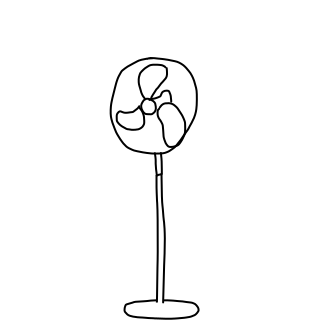
Someone had bought a big $60 fan at Costco and placed it beside the conveyor. When an empty box passed by, lighter and easier to push, the fan blew it off the line before it could become someone else’s problem.
The line kept running. The pallets stayed solid. The cleanup disappeared. Nobody had to trudge over with a sigh.
The multimillion-dollar system detected the empty box, but the person closest to the problem had removed it with a $60 fan.
Software is full of problems like that.
The pattern is familiar: we spend time and money building elaborate systems to notice failure, report it, retry it, assign it to the right person, and then document it in a very serious post-mortem.
Meanwhile, there may have been a small, boring, deeply unsexy change, almost embarrassing to suggest, that would have prevented the failure from existing in the first place.
Those little ideas die for obvious reasons. They do not look serious. They do not always fit the playbook. They do not come with a neat risk analysis to reassure everyone in the meeting.
Simplicity can look chaotic because it does not look like safety. Complexity, on the other hand, feels reassuring.
It looks serious. It looks rigorous. It gives the impression that someone thought of everything.
A $60 idea, not so much.
It feels like betting your credibility on something you cannot fully prove on a whiteboard. What if it breaks under the weight of real life? What if it works in the demo, but not in production? What if you look naive just for suggesting it?
So we go back to what feels reassuring: more layers, more tools, more process, the kind of things that are easy to defend in a meeting. Then, without really noticing, we end up building a monument to our fear of being wrong.
But people who create real gains often have a rare skill: they eliminate what does not matter. They edit.
They remove the abstraction. They ignore the fashionable pattern. They trade elegance on paper for something that stands up in real life. That is not a lack of rigor. It is not some janky fix dressed up as wisdom. Often, it is the opposite: a form of precision.
And there is another lesson hidden in the fan story: the best ideas often come from the people closest to the problem.
The ones who see the line stop every day. The ones who clean up the mess. The ones who get called when things break. The ones who watch customers struggle with a poorly designed flow, slowly, painfully, like a movie whose ending cannot be changed.
They are worth listening to, because those people are not always trying to sell a grand vision. Often, they just want the pain to stop.
And maybe that is the difference.
There is the hot air we sell: the kind that fills meetings, plans, post-mortems, and pretty documents that make it look like everything is under control.
And then there is the air that actually moves something.
In that story, the best idea was literally just air.
But it was in the right place.